How to Grow on YouTube in 2026: 14 Proven Tactics
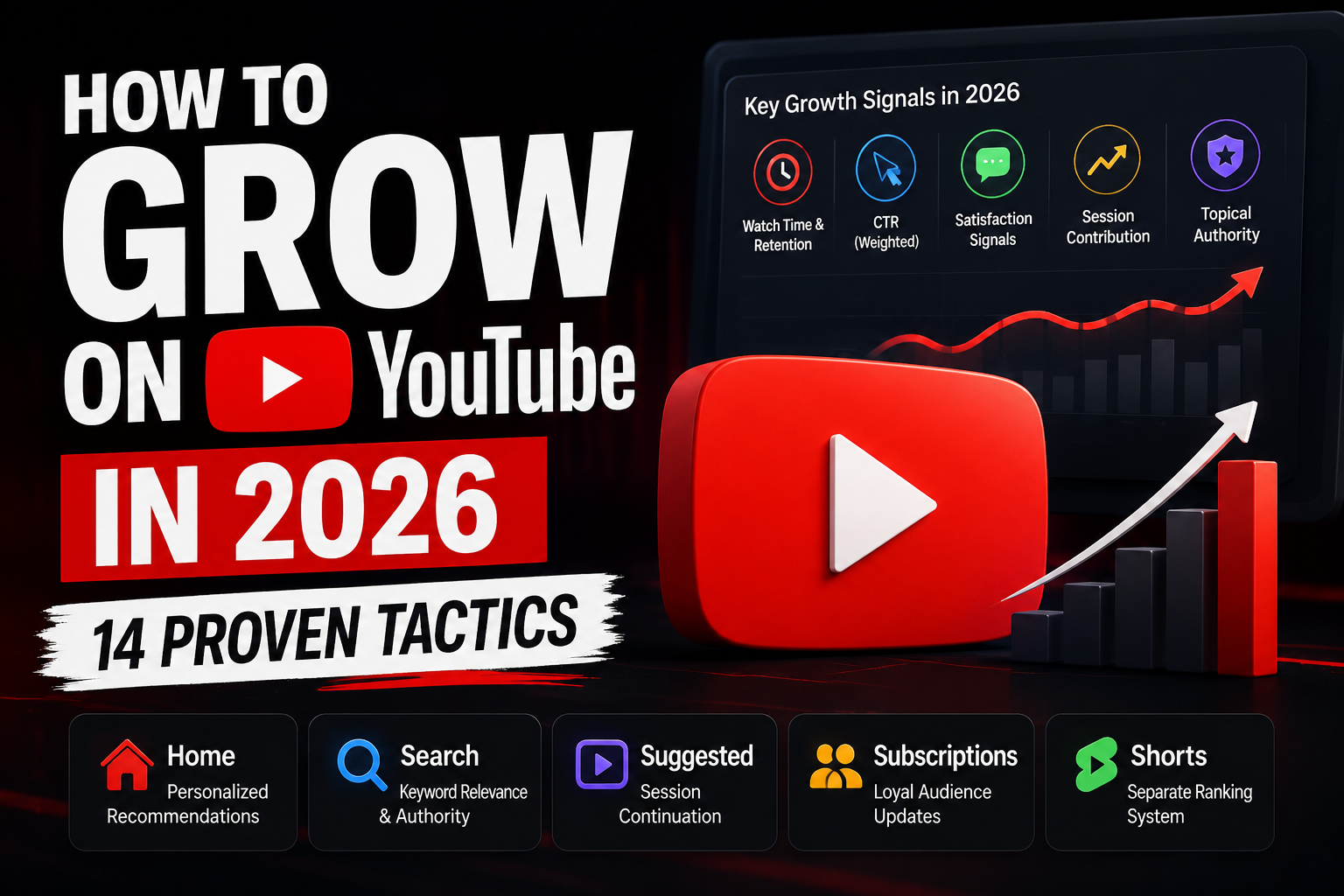
YouTube doesn't run on one algorithm, it runs on five separate recommendation systems: Home, Search, Suggested, Subscriptions, and Shorts, each weighing signals differently. Several analyses of 2026 changes point to the same shift: satisfaction signals (saves, rewatches, post-watch surveys, comment sentiment) are now sitting alongside and, in some reporting, above raw watch time as the top-level ranking driver. Click-through rate still matters, but it's weighted differently depending on whether the impression came from your existing subscribers or a cold audience.
This guide covers what's actually working right now, plus an honest section on when a paid growth service helps a YouTube channel and when it genuinely doesn't, including a YouTube-specific risk that most guides skip entirely: monetization eligibility.
1. How YouTube's Algorithm Actually Works in 2026
Treat "the YouTube algorithm" as five systems, not one:
- Home — personalized recommendations based on watch history and topic clusters
- Search — keyword relevance combined with watch time, retention, and channel authority
- Suggested/Up Next — session-continuation focused; rewards videos that keep a viewing session going
- Subscriptions feed — several analyses report this feed carries less weight in overall distribution than it used to, with personalized Home recommendations doing more of the discovery work even for subscribers
- Shorts — a genuinely separate ranking system based on completion rate, loop count, and swipe-away rate, not total watch time
Across systems, the signals that carry the most weight in current reporting are:
- Watch time and audience retention — the percentage of a video actually watched, not just total minutes
- CTR, weighted by traffic source — CTR from cold/Browse impressions is reported to carry meaningfully more weight than CTR from your existing subscribers, because it signals whether the algorithm's bet on a new audience paid off
- Satisfaction signals — likes, comments, rewatches, saves, and (where shown) post-watch survey responses
- Session contribution — whether your video keeps a viewer watching more afterward, or ends the session. Several analyses specifically flag checking your "next videos" watch-time data in Studio, since a video that reliably ends sessions can get suppressed even with otherwise solid metrics
- Topical authority — channel-level consistency in subject matter is increasingly treated as its own signal, similar to the niche-clarity shift seen on Instagram
One practical framework worth adopting: CTR gets you the click, retention earns the next impression. Optimizing only for one half of that equation is the most common reason creators see a promising-looking video quietly stop getting recommended.
2. Fix Your Channel Foundation Before You Upload
Every tactic below sends viewers to your channel page. If it doesn't convert a visit into a subscribe, you're losing growth at the last step.
- Channel name and handle: clear, searchable, consistent with your niche
- Channel description: keyword-relevant in the first two lines (this feeds Search relevance)
- Channel trailer: a short, specific pitch for non-subscribers, not a generic intro
- Playlists: organize your best content by topic; playlists boost session watch time by design
- Consistent branding: banner, profile image, and thumbnail style that's recognizable at a glance in a crowded Suggested feed
3. Long-Form vs. Shorts: Different Games, Different Rules
| Format | Ranking System | What Actually Drives Distribution |
|---|---|---|
| Long-form (8+ min) | Home, Search, Suggested | Watch time, retention curve, session contribution, satisfaction signals |
| Shorts | Independent Shorts feed | Completion rate, loop/rewatch count, swipe-away rate |
| Live/Premieres | Home, Subscriptions, Community | Real-time engagement, chat activity, first-hour CTR and notification opens |
The practical implication: Shorts are not a shortcut to long-form growth the way many creators assume. A Short performing well in its own feed doesn't automatically translate into long-form subscriber growth. It's a separate discovery channel with its own audience behavior. Use Shorts deliberately for top-of-funnel discovery and long-form for watch-time depth and monetizable session length, rather than treating one as a lite version of the other.
4. Thumbnails, Titles, and CTR
CTR is still one of the first gates a video has to pass, but the source of the impression changes how much it matters:
- Browse/Home impressions — highest-weighted CTR signal; this is the algorithm testing your video on a colder audience
- Search impressions — medium weight, blended with keyword relevance
- Suggested/Up Next impressions — weighted alongside session-continuation data
- Subscriber feed impressions — reported to carry the least CTR weight of the four, since subscribers already have context and intent
Practical takeaways:
- Design thumbnails for legibility at small size. Most Browse impressions happen on mobile
- Write titles that set an accurate expectation; a title that overpromises tanks retention even if it wins the click
- Test thumbnail/title pairs deliberately rather than "set and forget". Several sources report the effective testing window for early CTR signal has compressed compared to a couple years ago, so early performance in the first 24 hours matters more than it used to
5. Retention: The Metric That Decides Everything Else
Retention is the signal that determines whether a strong CTR turns into ongoing distribution or a one-time spike.
- Hook the first 15–30 seconds — state clearly what the viewer will get and why it's worth staying
- Cut dead air aggressively — pacing matters more than production polish for most channels
- Avoid padding for watch-time totals — several 2026 analyses specifically warn that stretching content to inflate raw minutes now backfires, since retention percentage and satisfaction signals matter more than total time watched
- Deliver on the title/thumbnail promise early, then build; don't save the payoff for the very end if the video is long
6. Upload Consistency Without Burning Out
There's no single "correct" upload frequency. It depends on format and production capacity. What matters more than raw frequency:
- A cadence your audience and the algorithm can learn (e.g., a fixed weekly long-form upload plus 2–3 Shorts)
- Community Posts between uploads — polls, behind-the-scenes images, and questions posted 2–3x/week are reported as a positive channel-level engagement signal that keeps the channel active in the algorithm's eyes between video releases
- Batch production — filming or editing multiple videos in one session protects consistency during busy periods
7. Growing Through Collaboration
- Guest appearances on established channels in your niche put you in front of an audience with existing trust
- Community tab engagement — replying to comments and polls signals an active, engaged channel
- Cross-promotion with creators in adjacent (not directly competing) niches
- Premieres for major releases — the pre-show chat window is reported to build anticipation that lifts first-hour CTR and notification open rates, both of which feed early satisfaction signals
8. Where Paid Growth Services Fit, Honestly
This is the section most guides either skip or oversell, and YouTube has a meaningfully different risk profile here than Instagram does.
The policy is explicit, not gray. YouTube's Fake Engagement Policy directly prohibits artificially inflating views, likes, comments, or subscribers, whether through automated systems or by serving content to unsuspecting viewers. This is more clear-cut than Instagram's more ambiguously enforced Terms of Service. Multiple independent analyses converge on a consistent risk picture:
- The realistic worst case for most casual purchases isn't a channel ban — it's wasted money, where purchased views or subscribers get identified and removed in a routine cleanup, and your counts simply drop back down
- Repeated or obvious abuse (bot-obvious accounts, instant massive spikes, automated engagement) is what escalates to strikes or channel-level consequences
- The biggest genuinely unique risk on YouTube is monetization. If you're pursuing or maintaining YouTube Partner Program eligibility, purchased engagement is specifically flagged across multiple sources as one of the most common reasons applications get rejected or channels get removed from the program after acceptance — YouTube reviews watch-time and subscriber quality directly during that review. If monetization is on your roadmap, don't mix purchased engagement into the metrics you're building toward it.
Lower-risk signals in a provider, if you're not pursuing monetization review:
- Never asks for your account password. Only needs your public channel URL
- Delivers gradually (drip-feed) rather than an instant spike
- Uses real, active-looking accounts rather than obvious bots
- Offers a refill/retention guarantee for natural drop-off
- Transparent about what's being delivered. No impossible bulk-for-pennies pricing
Red flags:
- Password or login requests
- Instant delivery of large volumes
- No refund, refill, or retention guarantee
- Vague or missing customer support
Where it genuinely helps: early social proof for a new channel or a specific launch, so a channel doesn't look like a ghost town to a first-time visitor deciding whether to subscribe. Where it doesn't help: substituting for retention and satisfaction signals; purchased subscribers and views don't watch, comment, or contribute to session length, and those are exactly the signals the 2026 algorithm weighs most heavily. A channel with an inflated subscriber count but low watch time per subscriber can actually look worse to the algorithm than a smaller, more engaged one.
If you do use a service, pair it with an active upload strategy and skip it entirely if Partner Program monetization is your near-term goal. SMMCute's YouTube services — subscribers, views, watch time, and likes are built around drip-feed delivery with real accounts and no password required, which matches the lower-risk profile described above.
9. Mistakes That Quietly Cap Your Growth
- Padding video length to chase raw watch-time totals — retention percentage and satisfaction now matter more than this trick ever earned
- Treating Shorts as a long-form growth hack — it's a separate discovery channel with its own rules, not a shortcut
- Ignoring the "next video" watch-time report — a video that quietly ends viewing sessions gets suppressed even with decent standalone metrics
- Buying engagement while pursuing Partner Program monetization — the single highest-risk mistake covered in this guide
- Posting across unrelated topics — undermines the topical-authority signal channels increasingly rely on for recommendation reach
10. How Long Does This Actually Take?
No honest guide gives you a universal number, but a realistic shape looks like:
- 0–3 months: channel foundation, format testing, and finding your retention baseline — growth is slow and noisy
- 3–6 months: patterns emerge in which topics, thumbnails, and formats actually hold retention; this is where most creators find their first real traction
- 6–12 months: compounding effect of a growing content library, playlists driving session watch time, and (if used) collaborations starts to show meaningfully in subscriber velocity
FAQs
Is it safe to buy YouTube subscribers in 2026? It's explicitly against YouTube's Fake Engagement Policy, and no provider can promise zero risk. For most casual purchases, the realistic worst case is wasted money as purchased engagement gets identified and removed, rather than a channel ban. But if you're pursuing monetization, purchased engagement can directly jeopardize Partner Program eligibility.
Do YouTube Shorts help grow my subscriber count? Indirectly, and not automatically. Shorts run on a completely separate ranking system (completion rate, loop count, swipe-away rate). They're a strong top-of-funnel discovery tool, but a well-performing Short doesn't guarantee long-form growth on its own.
What's a good CTR on YouTube in 2026? This varies significantly by niche and channel size, and reported benchmarks differ across analyses. Treat any specific percentage you see as a rough reference point, not a target, and compare your own videos against your own channel's baseline in YouTube Studio.
Does video length affect the algorithm? Not directly in the way it used to. Retention percentage and satisfaction signals now matter more than total watch-time minutes, so artificially padding length to chase watch time is reported to backfire rather than help.
How often should I upload to grow consistently? Consistency matters more than raw frequency. A sustainable weekly long-form cadence, supported by 2–3 Shorts and a couple of Community Posts, outperforms an unsustainable daily schedule that collapses after a few weeks.
Can buying views get my channel banned? Channel-level bans are reported as an unlikely outcome from a single purchase; the more common consequence is losing the purchased views/subscribers when they're identified and removed. Repeated, obvious abuse is what tends to escalate to strikes or account-level action.
Conclusion
YouTube growth in 2026 comes down to the same underlying goal it always has — keeping people watching and satisfied — but the algorithm has gotten sharper at measuring whether that's actually happening, across five different systems instead of one. Build your channel foundation properly, respect the very different rules Shorts and long-form play by, optimize for retention over raw watch time, and be clear-eyed about where a paid boost supports a real strategy versus where it risks the one thing YouTube treats as a hard line: monetization eligibility.
Ready to give your channel a head start? Browse SMMCute's YouTube services for real-account subscribers, views, and watch time with drip-feed delivery — or create a free account to see pricing.