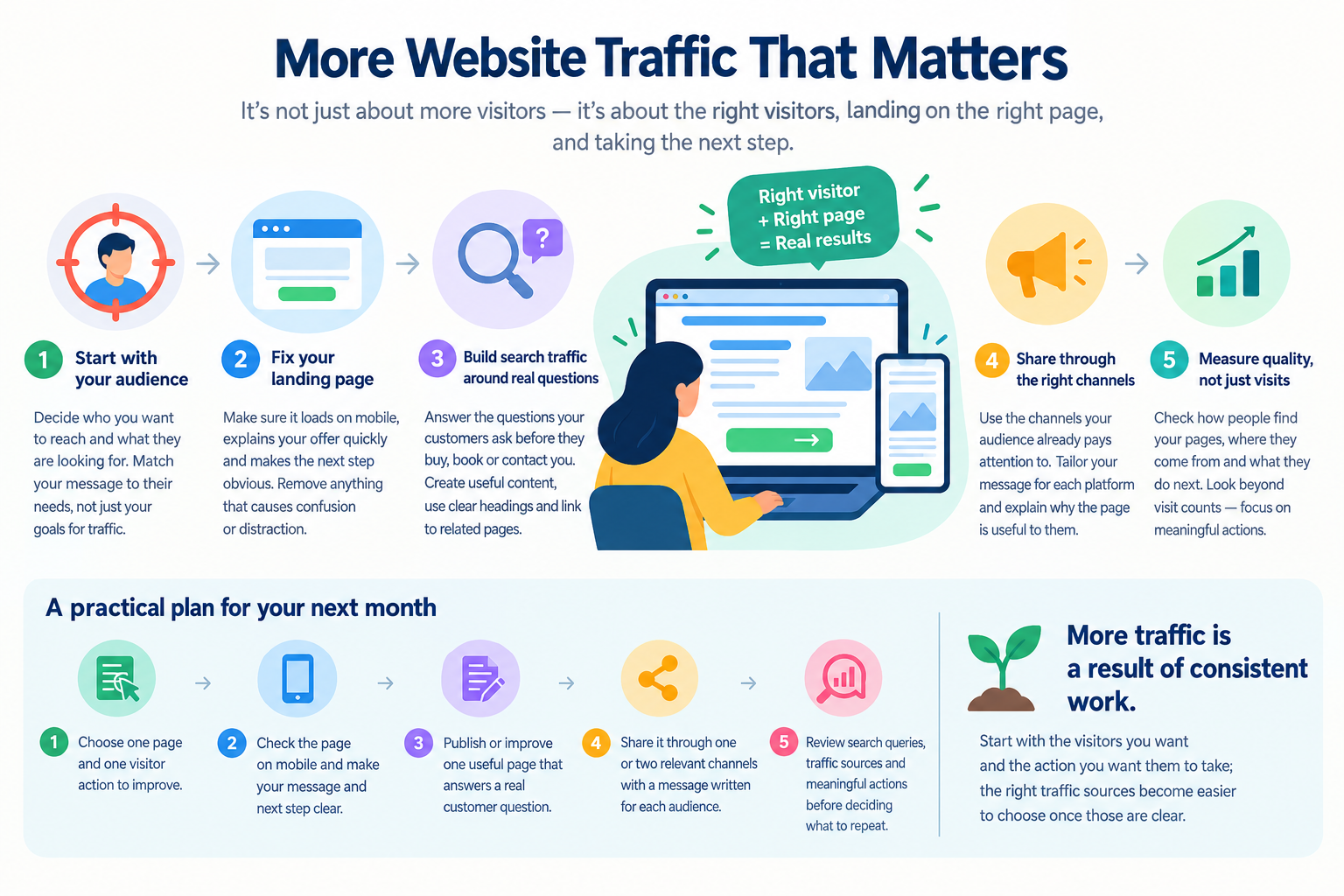
A higher visitor count can look impressive, but traffic is useful only when it reaches people who have a reason to be on your site. If visitors land on the wrong page, cannot find what they need or leave without taking the next step, increasing the count will not solve the real problem.
To get more website traffic that matters, work through the whole path: decide who you want to reach, choose channels that can reach them, make the destination page relevant, and measure what visitors do after they arrive.
Start with the action you want visitors to take
Choose one useful action for the page before trying to promote it. Depending on your business, that could be reading a guide, viewing a product, requesting a quote, signing up or contacting you. Then describe the visitor most likely to take that action and what they would be looking for.
For example, someone searching for a product’s setup instructions needs a helpful guide, while someone comparing prices needs a clear product or pricing page. Sending both people to a generic homepage adds friction because the page does not match either need.
Fix the landing page before sending more visitors
Open the page on a phone and check that it loads, explains the offer quickly and makes the next step obvious. Make sure the headline matches the message that brought the visitor there. Remove broken links, confusing forms and distractions that compete with the page’s main purpose.
Check the page itself as well as its design. A traffic campaign cannot make an unclear offer clearer, and a search result cannot compensate for content that does not answer the visitor’s question. Improve the destination first, then test additional traffic sources.
Build search traffic around real questions
Find the questions customers ask before they buy, book or contact you. Create a page that answers one closely related group of questions in a useful way. Use a clear page title and headings, explain the subject in plain language, and link to related pages where a reader may want more detail.
Google’s SEO guidance recommends creating useful, people-first content and making pages easy for people and search engines to understand. Its SEO Starter Guide covers titles, links, content and other basics. Search visibility takes time and no article can promise a ranking or a traffic total.
Use existing content to bring visitors to useful pages
When you publish a new guide, connect it to relevant product, service and supporting pages on your site. Add links where they help readers continue—not as a block of unrelated keywords. Review older articles too: update outdated details, fix broken links and add a link to a newer resource when it genuinely helps.
For a small online shop, an article explaining how to choose a product can link to the relevant category and buying guide. A software business could connect a troubleshooting article to setup instructions or the feature page that solves the problem. These links give readers a next step and help search engines discover related pages.
Share through channels where your audience already pays attention
Choose distribution channels based on your audience and the content. A short social post can introduce a useful guide; an email can send an update to people who asked to hear from you; a relevant partner or community may share a resource with the right context. Avoid posting the same generic message everywhere. Explain why the page may be useful to that audience.
If you run paid campaigns, start with a small, clearly defined test. Send each campaign to a page that matches its message, use tracking tags consistently, and compare the resulting visits with the action you actually care about. A large number of clicks alone does not show whether the campaign brought potential customers.
Measure traffic quality, not just total visits
Use Search Console to review how people find your pages in Google Search, including queries, impressions and clicks. If you use Google Analytics, its Traffic acquisition report can help you compare sessions by source, medium or campaign. Look beyond visits: check whether people reach the intended page, spend time with useful content or complete the action you set as the goal.
Compare similar periods and check whether a change in traffic source also changed the results you care about. A jump in visits can come from a campaign, a referral or a one-time event; it does not automatically mean that your search visibility or business results improved. See Google’s guides to the Traffic acquisition report and helpful, people-first content.
Know what a traffic service does—and does not measure
Some services are described in terms of visitors, sessions, page views, source or targeting. Those metrics are not interchangeable, and a visit does not necessarily represent an interested customer. Before ordering any website traffic service, check exactly what it counts, which destination URL it accepts, any targeting conditions and the service’s current terms.
A traffic service should not be treated as proof that a page has gained customers, conversions or better organic rankings. Measure the result against the goal you chose, and keep improving the page and the channels that reach relevant visitors. You can review SMMCute’s website traffic service guide for the categories and details available in your account.
A practical plan for your next month
- Choose one page and one visitor action to improve.
- Check the page on mobile and make its message and next step clear.
- Publish or improve one useful page that answers a real customer question.
- Share it through one or two relevant channels with a message written for each audience.
- Review search queries, traffic sources and meaningful actions before deciding what to repeat.
More traffic is a result of consistent work across content, distribution and the pages people land on. Start with the visitors you want and the action you want them to take; the right traffic sources become easier to choose once those are clear.